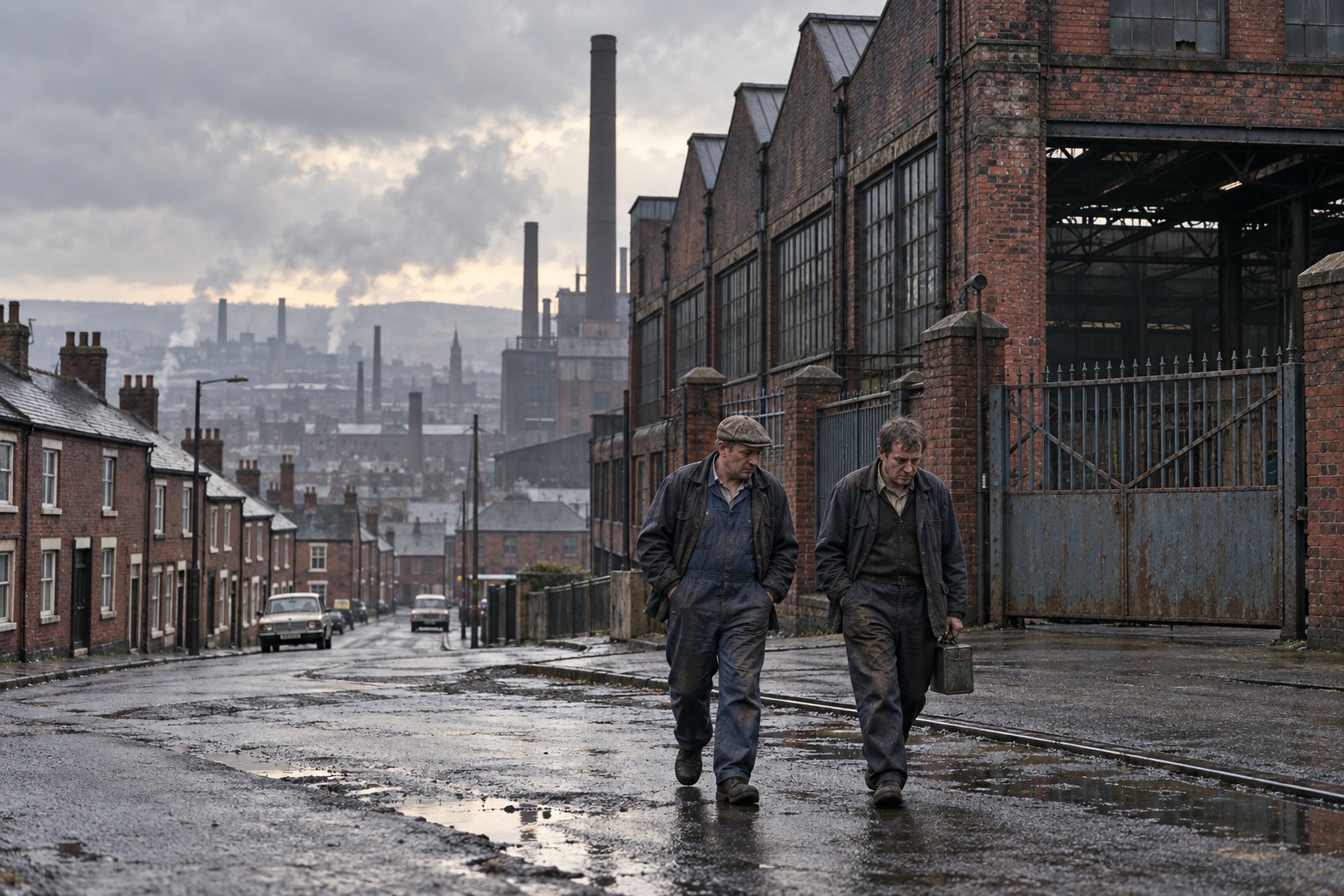
There’s a version of my generation doing the rounds that I hardly recognise. Cheap houses, secure jobs, good pensions. Apparently, we had everything handed to us, and now we’re sitting comfortably while younger people pay the bill.
Well, I’m 70, and I’m comfortable in retirement. I appreciate it enormously.
But before you decide I had an easy life, let me tell you about some of the years between starting work and finally stopping.
Yes, I had a good start
I started work at 15 in 1971. For the first five or six years, I felt as though I was living the dream. My wages were fine, my social life was excellent, and there were jobs available. Life was good.
I’m not going to pretend otherwise just to strengthen an argument.
I also remember being able to buy a property for roughly two and a half times my annual salary, with plenty of homes to choose from and access to a 100% mortgage. That was my experience in my area; it wasn’t a guarantee that everyone everywhere could do the same.
Those were real advantages. Younger people struggling to get a deposit together today have every reason to point them out.
But a good start at 15 doesn’t tell you what happened over the next half-century.
Education was another real advantage
We also had technical colleges, providing routes into practical skills and qualifications. University wasn’t the only way to get an education and move forward.
And for eligible students on supported university courses, tuition fees were paid through the public funding system. There were maintenance grants to help with living costs as well, with the amount depending on family income. These were grants, rather than money you had to repay. [9]
That was a significant advantage, and I’m happy to acknowledge it. It matters when we compare the opportunities available to different generations.
But those opportunities weren’t taken up by everyone, and receiving an education didn’t guarantee that your employer or your industry would survive.
We can recognise what was good about those years and still tell the truth about what was difficult.
Inflation, the three-day week and power cuts

Those happy memories of my early working years don’t mean Britain was sailing through without problems. I could enjoy being young and earning a wage while the country around me was going through serious upheaval.
We endured power cuts. Electricity was something you could suddenly have to manage without, with everyday routines interrupted when the power went off.
Then came the three-day week in early 1974, under Edward Heath’s Conservative government, years before Thatcher became Prime Minister. Restrictions limited electricity use by much of industry to three days a week to conserve fuel during the energy crisis and the miners’ dispute. Essential services had exemptions. It wasn’t a three-day working week that everybody had freely chosen. [7]
It was disruption to production and livelihoods. A shorter working week could mean less money coming into a household, rather than extra leisure to enjoy.
And there was inflation.
ONS figures show that annual average inflation measured by the Retail Prices Index was 16% in 1974, 24.2% in 1975 and 16.5% in 1976. Those figures describe the overall index; individual prices changed by different amounts. [8]
At 24.2%, a basket costing £10 would cost roughly £12.42 a year later if it rose at that rate. Unless your income kept pace, the same wage bought less.
So when we talk about cheaper houses and the opportunities available then, remember the wider picture too: power cuts, restrictions on industry and prices rising at a pace that made planning a household budget difficult.
I remember enjoying those early years. I also remember the power cuts. Both are part of the same life.
The promise and the years that followed
By the middle of the 1970s, I remember the atmosphere beginning to change. The national figures show unemployment was already a problem before Margaret Thatcher became Prime Minister in May 1979.
The famous Conservative poster, “Labour Isn’t Working”, first appeared in 1978. That long queue outside an unemployment office made a powerful point. [1]
The 1979 Conservative manifesto offered a change of direction, including tackling inflation and encouraging enterprise. People hoping for a more prosperous Britain could see something to vote for. [2]
But the years that followed brought severe hardship to many industrial communities.
According to the Office for National Statistics, the UK annual unemployment rate rose from 5.4% in 1979 to 11.5% in 1983. It remained above 10% through 1987. [3]
The House of Lords Library records that manufacturing had already lost around a million jobs between 1970 and 1979. Then another 1.5 million manufacturing jobs disappeared between 1979 and 1983 alone. [4]
The decline didn’t begin with one election. But its acceleration in those early 1980s years was something we lived through.
A brief history of deindustrialisation
Deindustrialisation means industry becoming a smaller part of the economy and its employment. It doesn’t mean Britain stopped making things altogether.
The shift was already under way in the 1960s and 1970s. British industry faced stronger international competition, pressure on profits and, in the 1970s, sharp increases in energy and material costs. Manufacturing employment was falling before Thatcher took office. [4]
The early 1980s brought a much faster decline. Her government prioritised reducing inflation, using high interest rates and restraint on public spending. The recession weakened demand, while a stronger pound made British exports more expensive abroad. These pressures helped accelerate manufacturing job losses. [4]
There was no single cause, and the history crossed governments of different parties. But government choices affected the speed of change and how communities were supported through it.
For people in a town built around industrial employment, the practical question was simple: what would replace the work that had gone?
An economy could recover nationally without the old factory reopening, or its former workers finding an equivalent job nearby. That is the gap between an economic recovery on paper and the recovery of a community.
The North–South divide
Where you lived mattered. Regional inequalities were already there when Thatcher took office, and the early 1980s brought mass unemployment to industrial communities across northern England, Wales and Scotland. The West Midlands suffered severely too.
In a January 1983 Commons debate, MPs compared contemporary regional unemployment rates for May 1979 and December 1982: 7.7% rising to 17.5% in the Northern region, 7% to 16.9% in Wales, 6.9% to 15.3% in Scotland, and 6.2% to 15.8% in the North West. These were contemporary registered/claimant unemployment figures, not the same measure as the ONS national rates quoted earlier. [10]
The regional divide wasn’t invented in hindsight. MPs were discussing it while it was happening. The South had unemployment too, and there were differences within each region. But a national average could hide just how badly particular industrial towns were suffering.
If the factory where you worked closed, and the neighbouring factories were cutting jobs as well, being told there were opportunities somewhere else offered little comfort.
When your town loses its work
I remember the industrial names around us: the Royal Ordnance Factory, Mitchells and Shackletons, Gardner, British Steel and the margarine factory. Across the wider area, there were the big employers and the factories around Trafford Park.
Over the years, familiar employers disappeared or changed beyond recognition. I’m describing the industrial landscape I remember, rather than putting every closure into the same year or giving each one the same cause.
To me, Trafford Park felt like a desert compared with what we had known.
And the effects spread beyond the factory gates. The meat industry, where I worked, was being hit too. Independent shops closed. Pubs struggled.
When wages disappear from a community, the businesses depending on those wages feel it as well.
At first, an old workmate might say, “There’s a vacancy or two where I am.”
Then he lost his job too.
Even the people you relied on to help you find work were looking for work themselves.
I stood in those queues
Over that period, I was made redundant five or six times. Some spells of unemployment lasted more than six weeks.
I stood in dole queues with men twice my age, chatting to old workmates. Skilled men. Men who had worked, provided for their families and taken pride in their trades.
The worst part wasn’t simply signing on. It was how useless it could make you feel when nobody seemed to need what you knew how to do.
Some of the men I knew were in their early fifties and never worked again.
That wasn’t an early retirement they had chosen. Their working lives had ended before they were ready.
When someone tells me our generation had it easy, those are some of the faces I remember.
What work replaced the factory jobs?
Much of the employment growth came in services. A parliamentary answer recorded that between June 1983 and June 1986, employment in services in Great Britain rose by 1.263 million, while manufacturing employment fell by another 220,000. Those totals include self-employment. They show where employment was growing, rather than tracking what happened to each displaced factory worker. [14]
Over the wider period, expanding service work included retail and distribution, hotels and catering, finance and business services, and professional work. Transport, storage, education and healthcare also formed part of the service economy. This was a shift over decades, rather than every closed factory being immediately replaced by a new employer. [15, 16]
That could mean work in a shop or supermarket, a warehouse, a hotel or restaurant, an office or a financial business. Some service jobs were skilled and well paid, and they created worthwhile careers.
But a new job elsewhere in the economy wasn’t automatically a suitable job for the person who had just lost one.
A skilled engineering worker couldn’t simply walk into an accountancy or banking role without the right qualifications and training. Other jobs might be accessible, but offer fewer hours, lower earnings or little opportunity to use an established trade. The practical questions were where the vacancy was, whether you could get it, and whether its wages would cover your bills.
That isn’t a criticism of people working in shops, hospitality or warehouses. Their work matters. It is a question about whether displaced workers could rebuild a comparable livelihood.
In my own case, taking £50 a week for work similar to a job that had paid £95 tells you what accepting the available work could mean.
And for some of the older men I knew, there was no replacement job at all.
Taking whatever you could get
People found ways to keep money coming in. Commission-only jobs appeared: double glazing and that sort of thing. Firms popped up and disappeared. A vacancy didn’t necessarily mean a dependable wage.
There was cash-in-hand work, and people were grateful to get it.
I remember taking a job paying £50 a week because the dole was paying me £25. Similar work had previously paid me £95 a week.
I accepted nearly half my previous wage because it was better than the alternative.
The bills didn’t fall by nearly half alongside it.
That helps explain a varied career. Sometimes you changed direction because you needed another way to earn a living.
Longer opening hours, shorter contracts
I also remember retail opening hours expanding, Sunday working at the ordinary rate of pay, and staff being expected to be increasingly flexible. For the customer, longer opening hours meant convenience. For workers, they could mean a working week that reached further into evenings and family time.
The dates need to be kept clear. The Sunday Trading Act 1994 changed the framework for Sunday shopping in England and Wales, after the 1980s period I’ve described. Sunday working does not automatically attract extra pay: a premium depends on the contract. Shop workers also have specific protections concerning Sunday work. [25, 26]
One memory stands out. Around 1987, I was a manager earning roughly £10,000 a year, and I had to implement the company’s decision to reduce staff contracts to 17½ hours a week. I then had to work out the rotas to cover the business. My understanding at the time was that the reduction saved the company employers’ National Insurance.
I objected to the cuts at the time. As the manager, I still had to implement the decision and organise the rotas, but that did not mean I agreed with it. I eventually left the company.
Longer opening hours still needed covering, but the individual staff contracts had been cut down.
The historical rules make that explanation plausible, but don’t prove the company’s motive. In 1987–88, neither employer nor employee paid Class 1 National Insurance when weekly earnings were below £39. The threshold was earnings, not hours. At 17½ hours, pay would have needed to be below approximately £2.23 an hour to remain under that limit, assuming no additional earnings took the weekly total over it. I don’t remember the staff’s hourly rates, and my own managerial salary doesn’t establish what they earned. The exact date, their weekly pay and the company’s calculations would need employment records to verify. [27]
That is why the number of jobs alone doesn’t tell the whole story. A short-hours contract may suit somebody who wants part-time work, but it can leave somebody needing a full wage searching for extra hours or a second job.
Agency work and zero-hours arrangements raise a related question: how much dependable income does the work provide? Agency work is not automatically a zero-hours contract, and not every agency role pays the minimum wage. Under a zero-hours arrangement, however, work is not guaranteed. [28]
The national minimum wage was introduced in April 1999, so it should not be used as a description of the national legal pay floor in 1987. [29]
These changes came at different times; Sunday trading did not by itself create insecure contracts. But the question running through my experience is the same: flexibility for the employer could mean uncertainty for the worker.
An hourly rate doesn’t pay the bills unless you can get enough paid hours.
Buying the house was only the beginning
I accept that my experience of buying a home looks favourable beside what many younger buyers face today.
But getting the keys and keeping the house are two different parts of the story.
A 100% mortgage meant borrowing the whole purchase price. You still had to find the repayments, including when your wages disappeared.
I remember my monthly mortgage payments more than doubling.
A November 1979 parliamentary debate recorded the forthcoming rise in building society mortgage rates to 15% from January 1980. That is a mortgage rate, rather than the Bank of England’s policy rate. [5]
A cheaper house could still become frighteningly difficult to keep when interest rates rose or you lost your job.
The repossession figures show how real that danger was. A parliamentary answer, using Council of Mortgage Lenders figures, recorded the following numbers of properties repossessed by mortgage lenders across the UK: [11]
| Year | Properties repossessed |
|---|---|
| 1980 | 3,480 |
| 1983 | 8,420 |
| 1986 | 24,090 |
| 1990 | 43,890 |
| 1991 | 75,540 |
Those are annual counts of properties, rather than numbers of individual people. The 1991 peak came after Thatcher had left office in November 1990, during the next recession. It should not be confused with the early 1980s crisis. But even by 1986, the annual total was nearly seven times its 1980 level.
Behind those figures were households losing their homes. A generation supposedly handed an easy route to homeownership also included thousands who could not keep the homes they had bought.
Younger people’s housing difficulties deserve serious attention. So does the insecurity people faced after buying in earlier decades. Both experiences belong in the discussion.
Council houses sold, without enough replacements
There is another part of the housing story we need to acknowledge. The Thatcher government introduced Right to Buy in 1980, enabling eligible council tenants to buy their homes at a discount. That gave many households an opportunity to become homeowners. [12]
But the homes sold out of social renting were not replaced in sufficient numbers. They still existed as buildings, but they were no longer council homes available to the next household needing an affordable tenancy.
A Commons committee report published in 2020 recorded almost two million Right to Buy sales in England since 1980, alongside a fall in total social housing stock from 5.52 million to 4.07 million. Those are changes over several decades and successive governments, rather than losses confined to Thatcher’s time in office. [13]
Restrictions on councils’ use of sales receipts also limited their ability to reinvest. From April 1990, rules required 75% of those receipts to be set aside for debt reduction. [13]
So the accurate criticism is that governments failed to replace what was sold in sufficient numbers. It would be wrong to say that no social homes were built at all.
That matters to younger people facing housing difficulties now. The decisions about selling homes, funding replacements and maintaining an affordable rented sector were government decisions. Blaming a whole generation obscures who made them and who had the power to change them.
The miners’ strike and the poll tax
The upheaval of those years also included the miners’ strike of 1984–85. At its heart was a struggle over pit closures, jobs and the future of mining communities. The dispute involved bitter divisions and violent confrontations between police and pickets, including the events at Orgreave on 18 June 1984. [17, 18]
Calling it simply “miners’ riots” leaves out the wider story: a prolonged industrial dispute with consequences for families and whole communities.
Then came the poll tax, officially called the Community Charge. It was introduced in Scotland in 1989 and England and Wales in 1990, replacing domestic rates with a charge based on individual adults. Its flat-rate structure drew fierce opposition; rebates and exemptions existed, but did not remove the controversy over fairness and affordability. [19, 20]
There were widespread protests and campaigns of non-payment. The London demonstration on 31 March 1990 ended in serious rioting, while a large demonstration in Glasgow that day was peaceful. The riot should not stand for everyone who opposed the tax. [21]
These were different disputes at different points in the decade, but both belong in the history of the Britain we lived through.
When people reduce those years to cheap houses and comfortable lives, they leave out the industrial conflict, the anger and the insecurity that were part of them too.
Later changes: immigration and local pressures
My working life continued long after the Thatcher years. Immigration became another source of public argument, and I remember people complaining about Polish people coming here.
The major expansion in Polish migration followed Poland joining the European Union in 2004, under Tony Blair’s Labour government. Polish communities were here before then, but this later increase belongs to a different chapter of the story. ONS estimates put the Polish-born UK population at around 95,000 in 2004 and 679,000 in 2013. [22]
Concerns about work, wages, housing and public services deserve examination. A growing population can add demand for homes and services, and pressures can be concentrated in particular places. A Commons committee recorded local challenges involving schools, housing and other services. [23]
But hearing complaints isn’t the same as proving every claim behind them. Research reviewed by Oxford’s Migration Observatory generally finds small effects on UK-born workers’ wages and employment, with some negative wage effects concentrated among lower-paid workers. Migrants also spend money, help create demand and fill jobs. [24]
Nor does pressure on housing establish that migrants were given unfair priority. The Commons committee reported that the housing-allocation research it examined found no evidence of privileged access for migrants. [23]
The questions I would put to government and employers are practical: were housing and services planned for population growth, were wages and employment standards protected, and were local concerns answered honestly?
We can discuss those pressures without assuming that Polish workers were responsible for the factory closures of the early 1980s, or that nationality alone tells us who benefited and who struggled.
Look at the whole working life
I worked from 1971 until retiring in 2022: a span of 51 years, with the interruptions I’ve described.
Looking at me today tells you very little about all those years.
A retirement photograph doesn’t show the dole queue. A mortgage-free home doesn’t show the months when keeping it was a worry. An afternoon doing something I enjoy doesn’t show the years spent finding another job and starting again.
I’m pleased with the life I have now. My wife and I have enough, and I feel fortunate. Sometimes I have money in my wallet and can’t think of anything I need to spend it on.
But comfort today doesn’t prove that the journey was comfortable.
Nor does my position describe every pensioner’s circumstances.
Retirement security matters at every age
The full new State Pension for 2026–27 is £241.30 a week, equivalent to £12,547.60 over 52 weeks. That is the full rate; what someone receives depends on their National Insurance record. [6]
It is reasonable to debate how pensions and social care are funded. I support care for people who need it, including younger adults.
But those debates need to consider what people can afford and what an income change would mean for their household. Calling somebody a wealthy boomer doesn’t answer either question.
Younger workers deserve affordable homes, worthwhile work and a retirement they can look forward to. I want those things for my children and grandchildren too.
Taking security away from one age group doesn’t, by itself, provide it for another.
Remember the whole story
I’m not asking anyone to deny the advantages my generation had. I’ve named some of mine plainly.
I’m asking people to remember what happened afterwards: the power cuts, the three-day week, the inflation, the redundancies, the wage cuts, the punishing mortgage payments and the men whose working lives ended long before they should have.
Younger people’s struggles are real. So were ours.
We can recognise both and demand better answers from the people making decisions about jobs, housing and retirement.
When I look back, if I’m honest, I feel a little anger. I remember the opportunities we had, but I also remember the jobs disappearing, the homes people lost and the insecurity that followed.
Politicians of different parties have made decisions that shaped those lives. Yet still they prattle on about prosperity, opportunity and a better future. After hearing it for decades, I want more than another promise. I want them to explain what they will do, why it will work, and how they will answer for it if it doesn’t.
I’m grateful for my retirement. But that gratitude doesn’t mean I have to forget what happened along the way—or stay quiet about what younger people face now.
I don’t want my children and grandchildren to go through the difficulties we faced. I want them to keep the opportunities we had—affordable homes, access to education and worthwhile work—and have greater security than we did.
Don’t confuse the retirement I’ve managed to reach with the life I had to work through.
That’s my dose of Dave. What do you remember about finding work and keeping a home in those years? And if you’re younger, what would make the biggest difference to your security today?